

Time for tea and a slice of Cake? Try this delicious gluten teabread http://t.co/kYFawJ5iVP # DKbooks #Gut Feeling #Gluten Free
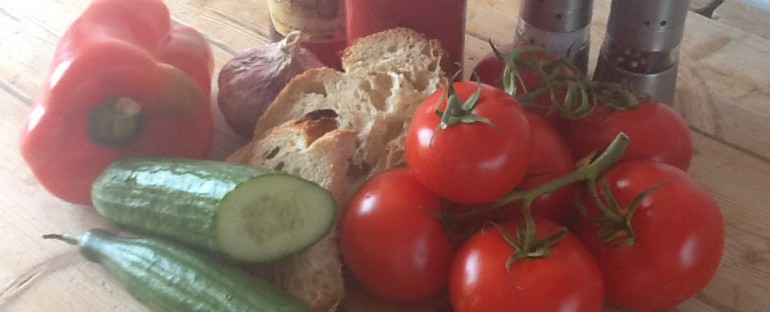
Now that summer has finally arrived one of my favourite things to eat for lunch is gazpacho. It’s quick to make, healthy and wonderfully refreshing – what more could a girl want? Although I enjoy cooking, and don’t as a rule buy alot of processed foods, I must confess that, until recently I have always bought ready-made gazpacho. There are several different brands on sale in our local supermarket so a couple of weeks ago when I was visiting some farmers in Almeria in southern Spain (more about that visit in my next blog), I asked my hosts which brand they thought was the best and most authentic. My question was met with a look of complete bewilderment. Why would I buy ready-made gazpacho when it’s so easy to make, they wanted to know. That is, of course, an excellent question. So yesterday I thought I’d give it a go. I’m happy to report that it really could not be easier to make – once all the ingredients were assembled it took less than 5 minutes to make, and without wishing to appear too boastful it tasted utterly delicious. If you want to see a short film of me making gazpacho click on this link www.vine.co/v/hZQKxKaLJ7K/embed Although gazpacho is a classic dish from the Andalucían area of Spain, I suspect the recipe is fairly flexible. However the one thing that is absolutely essential for the dish is ripe tomatoes. Gazpacho needs to be served well chilled so although it only takes a couple of minutes to make it’s worth making it a couple of hours before you want to eat it so you have time to chill it properly. I like to add an ice cube just before serving and garnish the gazpacho with small cubes of red and green pepper, diced avocado, mild Spanish onion. If I’m serving it as a first course for a dinner party I like to add a swirl of fresh pesto, although I suspect that might cause a few raised eyebrows among the Spanish farmers! As well as a tasty nutritious lunch it’s also a great dish to serve as a starter for a summer dinner party. It’s diet friendly and suitable for all sorts of special diets including dairy free, vegetarian, vegan. Although the recipe below uses bread if you’re following a gluten or wheat free diet simply leave the bread out and then it would be gluten free too. Gazpacho Serves 6 - 8 1kg ripe tomatoes 1 pepper 2 fat cloves garlic, peeled 100g white bread 1 cucumber 150mls olive oil 3tbsp red wine or sherry vinegar Salt and freshly ground black pepper to taste To garnish: some or all of the following – diced red and green pepper, Spanish onion, avocado, cucumber, fresh pesto, fresh mint, black olives, Soak the bread in a bowl of cold water for 10-15mins, then squeeze out as much water as possible. Place all the ingredients in a blender or food processor and process until smooth. If you like a smooth soup pass the mixture through a sieve to remove seeds and skins (I did this the first time I made the recipe but didn’t bother the second time and it tasted just as good). Chill for at least an hour and then serve garnished with whatever takes your fancy. Nutrition notes: Per serving: based of 6 servings 247cals-12% 8g sugar – 9% 19g fat – 28% 3g saturated fat – 15% 0.3g salt – 5% One bowl contains over 75% of the Recommended Daily intake of Vitamin C and 3 of your five a day servings Suitable for vegetarians, vegans, dairy free and can easily be adapted to make it gluten and wheat free.
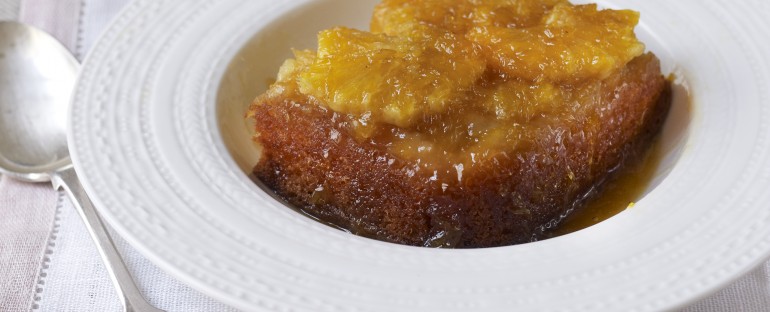
Day 4 of Gut Feeling week and here’s another lovely recipe from the Gluten Free Cook Book, DK ( ISBN 978 -1-4053-9431-4). Don’t forget 2 lucky people can win an copy of the book. All you need to do is post the correct answer to the question below and your email address in the comments box at the end of this post. Good Luck ! Which of the following grains is NOT gluten free a) Spelt b) Buckwheat c) Quinoa Caramelized Orange Pudding Serves 10 PREP 20 mins Cook 30–40 MINS Be patient when baking this tangy, orange-topped sponge. Don’t open the oven for a peep too early or the pudding won’t rise and it may even sink 75g (91⁄2oz) unsalted butter, plus extra for greasing 3–4 oranges, peeled, pith and pips removed, and thickly sliced 3–4 tbsp demerara sugar 115g (4oz) gluten-free self-raising flour 1 tsp gluten-free baking powder 1 tsp xanthan gum 175g (6oz) golden caster sugar 3 eggs 3 tbsp milk crème fraîche, or gluten-free custard, to serve Per serving Energy 643kcals/2646kJ Protein 7g Fat 42g Saturated fat 25g Carbohydrate 57g Sugar 44g Fibre 3g Salt 0.9g
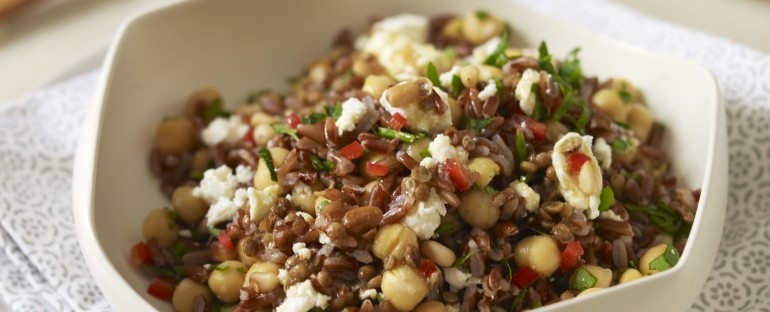
Day 3 of Gut Feeling Week www.coeliac.org.uk) and here another recipe from the Gluten Free Cook Book DK (ISBN 978-1-4053-9431-4). Don’t forget 2 lucky people can win a copy of the book - details of what you need to do are in mondays post. Chickpea, red rice, and artichoke salad Serves 4 Prep 10 mins Cook 35 mins A substantial main meal salad, it’s also good as a side dish to accompany grilled or barbecued salmon or chicken. 400g (14oz) Camargue red rice 400g can chickpeas, drained and rinsed 280g jar roasted artichokes, drained 1 red chilli, deseeded and finely chopped handful of fresh coriander, finely chopped handful of flat-leaf parsley, finely chopped 2 tbsp pine nuts, toasted 75g (21⁄2oz) feta cheese, crumbled For the coriander and orange dressing 6 tbsp extra virgin olive oil 2 tbsp white wine vinegar juice of 1 large orange 11⁄2 tsp coriander seeds, lightly crushed 1 tsp Dijon mustard pinch of sugar salt and freshly ground black pepper 1 For the dressing, place all the ingredients in a small bowl or jug and mix well. Taste and adjust the seasoning as required. 2 Place the rice in a large pan of salted water and cook according to pack instructions until tender. Drain well and transfer to a serving bowl. 3 While the rice is still warm, stir through the chickpeas, artichokes, chilli, and herbs, and mix well. Pour the dressing over the rice mixture and toss together. Taste and adjust the seasoning. Top with the pine nuts and feta Cook’s tip Camargue red rice has a slightly nutty taste. You can also use half Camargue rice and half basmati rice. Nutrient Boost Soluble fibre in chickpeas helps balance blood sugar and reduce cholesterol. statistics per serving Energy 710kcals/2958kJ Protein 17g Fat 28g Saturated fat 5.5g Carbohydrate 90g Sugar 7g Fibre 5g Salt 1.3g
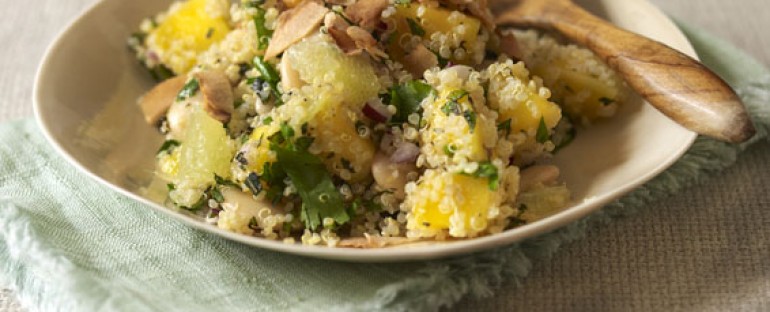
Day 2 of Gut Feeling Week (www.coeliac.org.uk) and here’s another lovely recipe taken from The Gluten Free Cook Book DK (ISBN 978-1-4053-9431-4). Don’t forget 2 lucky people can win a copy of the book - details of what you need to do are in yesterdays post. Quinoa salad with mango, lime, and toasted coconut Serves 4 Prep 15 mins Cook 10 mins A healthy salad full of big, tropical flavours and bright colours. Try to get Alphonso mangoes, if possible, which are famed for their sweetness. 1 Toast the coconut by dry frying it in a pan over a medium heat for 2–3 minutes until golden, stirring so that it doesn’t burn. Remove from the heat and allow to cool. 2 To make the dressing, place all the ingredients in a small bowl or jug and whisk. Taste and adjust the seasoning as needed. 3 Cook the quinoa according to pack instructions. Drain well and tip into a large serving bowl. While the quinoa is still warm, stir through the butter beans, onion, mango, lime, mint, and parsley, and season. 4 Pour over the dressing and stir well. Sprinkle the toasted coconut on top and serve immediately. 50g (13⁄4oz) desiccated or flaked coconut 300g (10oz) quinoa 400g can butter beans, drained and rinsed 1⁄2 red onion, finely chopped 1 large mango, peeled, stoned, and cut into bite-sized pieces 1 lime, peeled, segmented, and segments halved handful of mint, finely chopped handful of flat-leaf parsley, finely chopped For the dressing 3 tbsp olive oil 1 tbsp white wine vinegar pinch of sugar salt and freshly ground black pepper Per serving Energy 460kcals/1935kJ Protein 15g Fat 20g Saturated fat 8g Carbohydrate 54g Sugar 12.5g Fibre 7.5g Salt 0.8g
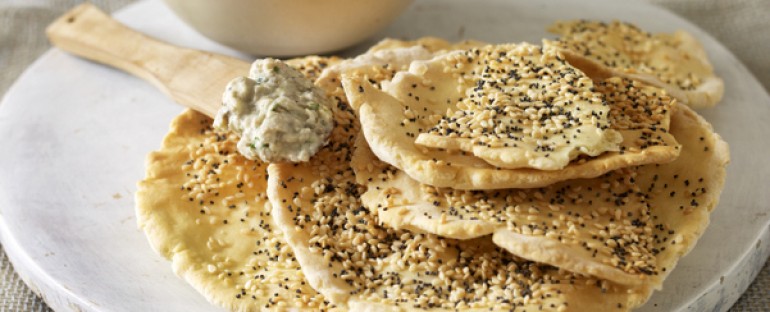
Lavosh with aubergine dip Serves 8 Prep 20 mins Cook 1 HOUR 10 MINS Iranian-style seeded crisp breads served with a sesame scented aubergine dip perfect for a snack or appetiser. 150g (51⁄2oz) gluten-free plain flour, plus extra for dusting 2 tsp xanthan gum 1⁄2 tsp salt 2 egg whites 15g (1⁄2oz) butter, melted 2 tbsp sesame seeds 1 tbsp poppy seeds For the dip 2 medium aubergines 2 garlic cloves, crushed zest and juice of 1 lemon 3 tbsp tahini paste 1⁄2 tsp salt 90ml (3fl oz) olive oil 3 tbsp finely chopped fresh coriander 4 tbsp Greek yogurt freshly ground black pepper 1 Preheat the oven to 200°C (400°F/Gas 6). For the dip, bake the aubergines on a baking tray for 30–40 minutes or until soft and lightly charred. Cool. 2 Meanwhile, make the lavosh. Sift the flour, xanthan, and salt into a large bowl. Beat 1 egg white with 90ml (3fl oz) water, stir into the flour with the melted butter, and mix well to form a dough. Lightly knead the dough on a floured surface, divide into 6 balls, and roll out each ball until paper thin, then place on baking sheets. Repeat with all the dough. 3 Brush the remaining egg white over the lavosh, sprinkle the seeds, and bake in 2 batches for 10–15 minutes or until crisp and golden. 4 Halve the aubergines and scoop the flesh into a food processor. Add the rest of the ingredients and blend to a chunky spread. Check the seasoning, spoon into a bowl, and serve with the crisp breads. Cook’s Tip You can also store the lavosh, after it has cooled, in an airtight container for 2–3 days. Re-crisp in a warm oven. The dip can be stored for 2–3 days in an airtight container in the fridge. Per serving Energy 226kcals/994kJ Protein 5.5g Fat 17g Saturated fat 3.5g Carbohydrate 15.5g Sugar 1.5g Fibre 3g Salt 0.6g Recipe from The Gluten Free Cook Book, Heather Whinney, Jane Lawrie & Fiona Hunter DK publishing (ISBN 978-1-4053-9431-4)
Several years ago my other half was knocked off his bike and fractured his skull. Thankfully he’s now fully recovered, but one of the long term consequences of the accident was that he lost his sense of smell (bilateral anosmia for those of you who like to get technical). Much of what we taste actually comes via the olfactory nerve, which in Tim’s case is damaged and doesn’t do what its suppose to do and as a result his food can taste rather bland and insipid (nothing to do with my cooking!). To make his food taste of something, he likes to add lots of salt (well he would if he didn’t live with a nutritionist) so I’m always looking for ways to enhance the flavour of food without adding too much salt. Dukkah does the job perfectly. Dukkah is an Egyptian spice mix made from a blend of nuts and seeds. The word is derived from the Arabic for ‘to pound’ since the mixture of spices and nuts are pounded together after being dry roasted. It’s delicious scattered over salads, hummus, vegetables, fish or chicken, in fact, we sprinkle it over pretty much everything we eat at the moment. You can experiment with different nuts and spice blends. I’ve replaced almonds with hazelnuts and pistachio nuts and both work well. Adding a touch of smoked paprika adds a delicious smokiness or sumac gives a subtle hint of lemon. I add a small amount of salt which seems to bring out the flavours of the other spices but it’s only a small amount and you can leave it out if you want to. Ingredients: 75g almonds 4 tablespoons sesame seeds 2 tablespoons cumin seeds 1 tablespoon coriander seeds ½ tsp chilli flakes ½ tsp smoked paprika ½ teaspoon salt, optional Method: 1. Preheat oven to 180C. Place the almonds on a non-stick baking the tray and bake for 10 mins. Allow to cool. 2. Heat a small non-stick frying pan, once the pan is hot add the cumin, coriander and sesame seeds and dry roast for 30seconds. 3. Place all the ingredient is a smaller blender and process to a coarse powder. 4. Store in an airtight container for up to 1 month.
 Latest Tweets
 RT @healthyfoodmag: If colder days and darker nights leave you feeling miserable, this article is for you. HFG nutritionist,… Click here for link,
 - Lunch at Flax and Kale, #superhealthy #super tasty #❤️Barcelona @ Barcelona, Spain Click here for link,
- Why cooking from scratch is the way forward Click here for link,
- RT @TelegraphFood: Is organic food really healthier? Nutritionist @fiona_nutrition helps bust the biggest food myths
Click here for link,