

Time for tea and a slice of Cake? Try this delicious gluten teabread http://t.co/kYFawJ5iVP # DKbooks #Gut Feeling #Gluten Free
Monthly Archives: May 2013

Brain Food: Keep Calm and Carrying on Eating It’s that time of year again when some people wake up and, for a carefree moment, the sun is shining and all is well with the world, then it hits you ……..that sick feeling, a feeling of dread and terror, a dead weight in the pit of your stomach and you then you remember why………. it’s exam time! My beautiful niece Amy is in the middle of her A/S levels and it was her idea for me to write something about what to eat to beat exam stress. The effect of diet on brain chemistry and cognition it a relatively new but very exciting area of nutrition and one that I plan to write more about at some point. But, if like Amy, you’re in the middle of revising for or taking exams right now here are some tips that may help you concentrate better, think faster, and deal with exam stress. Start the day right - although you might not feel like eating when you first get up, particularly on the morning of an exam, breakfast really is the most important meal of the day. Studies show that people who eat breakfast think faster and remember things better. If that isn’t enough incentive to eat breakfast I don’t know what is. The fact of the matter is, if you want your brain to work properly in the morning you’ve got to give it the fuel to do so, which means breakfast. Another reason for eating breakfast, especially on the day of an exam, is that you want your mental focus to be on your exam not on a rumbling tummy. The best choice for breakfast is something that combines low GI ‘slow release’ carbs and some protein, so porridge or muesli or eggs or peanut butter on wholemeal toast are good options. Low GI/slow release carbs are broken down into sugar slowly which will help to keep your blood sugar level stable and that’s a good thing because a dip in blood sugar can mean a dip in concentration and brain power. Eat regularly - the food you eat provides the fuel your brain needs so if you skip meals and your blood sugar level drops your brain might decide to go on a bit of a go-slow. When you’re revising take a short break every 2-3hours, rest your brain, stretch your muscles, have a drink and a healthy snack. Good choices for snacks include fruit, a couple of oatcakes with hummus or peanut butter, wholemeal toast or a smoothie. On days when you have an exam, especially if it’s going to be a long one, take bottle of water and small snack like a banana or some dried fruit and nuts into the exam room with you. Don’t eat too late at night – when you’re studying hard your brain needs time to relax and the best way to help it relax is with a good night’s sleep. A heavy meal too close to bedtime can interfere with sleep, so try to have your last meal at least 3 hours before you go to bed, but going to bed hungry can also make it more difficult to sleep so if you eat early have a small snack like a milky drink or a bowl of cereal before you go to bed. Avoid all caffeine containing food and drinks (tea, coffee, cola and chocolate) for least 4 hours before going to bed – some people who are very sensitive to caffeine can still feel the effect 12 hours later. Look after your body as well as your brain – I don’t need to tell you how stressful exams are but what you might not know is that stress can affect the balance of good and bacteria that we have living in our gut. This can take its toll on your immune system making you more vulnerable to colds and stuff. There’s never a good time to be ill but the run up to exams has to be one of the worst so to keep your immune system healthy I recommend taking a probiotic supplement like Actimel or Yakult Don’t forget to drink - your brain is around 75% water and to work efficiently it needs to be kept properly hydrated. If you don’t drink enough you will find it more difficult concentrate, and you’re more likely to get a headache. Water is the healthiest thing to drink (don’t forget to take a bottle into the exam room with you) but if you fancy something a bit more exciting go for fruit squash or some flavoured milk. Avoid too many fizzy drinks – even the sugar free variety can damage your teeth. Good to anyone taking exams - especially to you Amy !
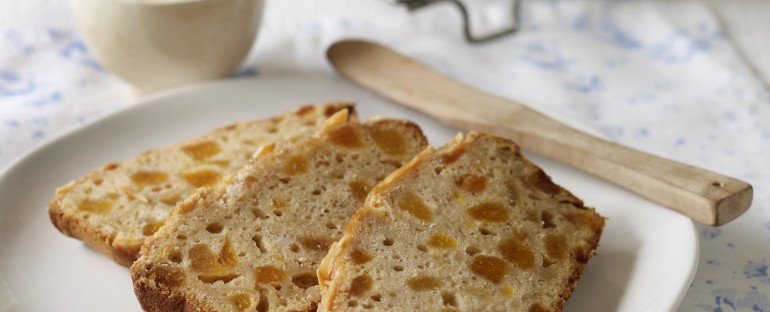
Have you got that Friday afternoon feeling ? Then its obviously time for a cup of tea a slice of cake, so why not try this delicious gluten free option from the Gluten Free Cook Book , DK (ISBN 978-1-4053-9431-4). To win a copy of the book simply leave the answer to the following question along with your email address at the end of this post (NB you need to subscribe to the site to post your answer) Which of the following are NOT gluten free a) spelt b) buckwheat c) quinoa Apricot and cardamom Teabread Serves 12 P rep 15 mins Cook 1¼–1½ Hours FREEZE: 2 MON THS Earl Grey tea adds a lovely citrus note to this wonderfully moist teabread, but any other tea will work too. 1 tea bag, such as Earl Grey 225g (8oz) ready-to-eat dried apricots, finely chopped 6 cardamom pods, split 175g (6oz) light muscovado sugar oil, for greasing 225g (8oz) gluten-free plain flour 1 tsp gluten-free baking powder 1 tsp xanthan gum 1 tsp ground cinnamon pinch of salt 75g (21⁄2oz) cold unslated butter, cubed 2 eggs, beaten 15g (1⁄2oz) flaked almonds 2 tbsp demerara sugar butter, to serve Special Equipment 900g (2lb) loaf tin 1 Pour 300ml (10fl oz) boiling water over the tea bag and leave to infuse for 5 minutes. Place the apricots in a small pan. Remove the tea bag and add the hot tea, cardamom, and sugar to the pan. Bring to the boil, then simmer, uncovered, for 10 minutes. Leave until cold; the apricot mixture will cool quickly if tipped into a shallow tray. Remove the cardamom pods. 2 Preheat the oven to 180°C (350°F/Gas 4). Lightly oil the tin and line the base with baking parchment. Sift the flour, baking powder, xanthan, cinnamon, and salt into a large bowl. Rub the butter into the flour mixture. Stir the cold apricots and their cooking liquid into the flour, add the eggs, and beat together. Pour into the tin and scatter over the almonds and demerara sugar. Bake in the centre of the oven for 1 hour 20–25 minutes or until well risen and firm to the touch. 3 Cool in the tin for 10 minutes before transferring to a wire rack to cool completely. The tea bread is even better the day after baking and will keep in an airtight container for up to 1 week. Per slice Energy 225kcals/948kJ Protein 4g Fat 7g Saturated fat 3.5g Carbohydrate 36g Sugar 23g Fibre 2.4g Salt 0.3g
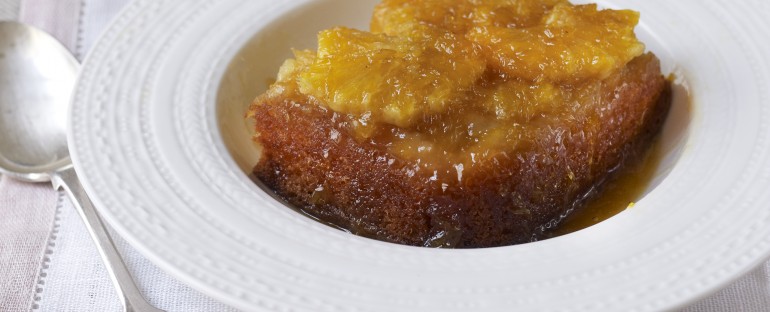
Day 4 of Gut Feeling week and here’s another lovely recipe from the Gluten Free Cook Book, DK ( ISBN 978 -1-4053-9431-4). Don’t forget 2 lucky people can win an copy of the book. All you need to do is post the correct answer to the question below and your email address in the comments box at the end of this post. Good Luck ! Which of the following grains is NOT gluten free a) Spelt b) Buckwheat c) Quinoa Caramelized Orange Pudding Serves 10 PREP 20 mins Cook 30–40 MINS Be patient when baking this tangy, orange-topped sponge. Don’t open the oven for a peep too early or the pudding won’t rise and it may even sink 75g (91⁄2oz) unsalted butter, plus extra for greasing 3–4 oranges, peeled, pith and pips removed, and thickly sliced 3–4 tbsp demerara sugar 115g (4oz) gluten-free self-raising flour 1 tsp gluten-free baking powder 1 tsp xanthan gum 175g (6oz) golden caster sugar 3 eggs 3 tbsp milk crème fraîche, or gluten-free custard, to serve Per serving Energy 643kcals/2646kJ Protein 7g Fat 42g Saturated fat 25g Carbohydrate 57g Sugar 44g Fibre 3g Salt 0.9g
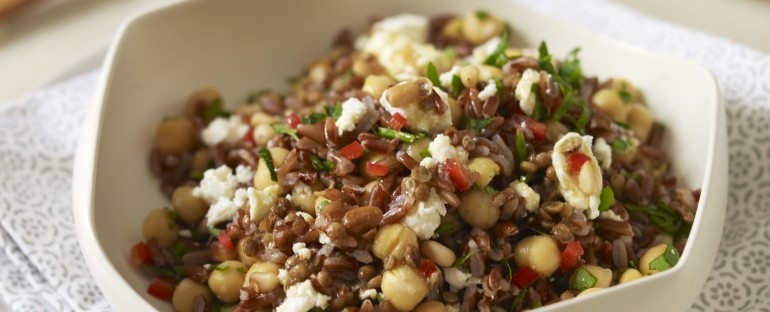
Day 3 of Gut Feeling Week www.coeliac.org.uk) and here another recipe from the Gluten Free Cook Book DK (ISBN 978-1-4053-9431-4). Don’t forget 2 lucky people can win a copy of the book - details of what you need to do are in mondays post. Chickpea, red rice, and artichoke salad Serves 4 Prep 10 mins Cook 35 mins A substantial main meal salad, it’s also good as a side dish to accompany grilled or barbecued salmon or chicken. 400g (14oz) Camargue red rice 400g can chickpeas, drained and rinsed 280g jar roasted artichokes, drained 1 red chilli, deseeded and finely chopped handful of fresh coriander, finely chopped handful of flat-leaf parsley, finely chopped 2 tbsp pine nuts, toasted 75g (21⁄2oz) feta cheese, crumbled For the coriander and orange dressing 6 tbsp extra virgin olive oil 2 tbsp white wine vinegar juice of 1 large orange 11⁄2 tsp coriander seeds, lightly crushed 1 tsp Dijon mustard pinch of sugar salt and freshly ground black pepper 1 For the dressing, place all the ingredients in a small bowl or jug and mix well. Taste and adjust the seasoning as required. 2 Place the rice in a large pan of salted water and cook according to pack instructions until tender. Drain well and transfer to a serving bowl. 3 While the rice is still warm, stir through the chickpeas, artichokes, chilli, and herbs, and mix well. Pour the dressing over the rice mixture and toss together. Taste and adjust the seasoning. Top with the pine nuts and feta Cook’s tip Camargue red rice has a slightly nutty taste. You can also use half Camargue rice and half basmati rice. Nutrient Boost Soluble fibre in chickpeas helps balance blood sugar and reduce cholesterol. statistics per serving Energy 710kcals/2958kJ Protein 17g Fat 28g Saturated fat 5.5g Carbohydrate 90g Sugar 7g Fibre 5g Salt 1.3g
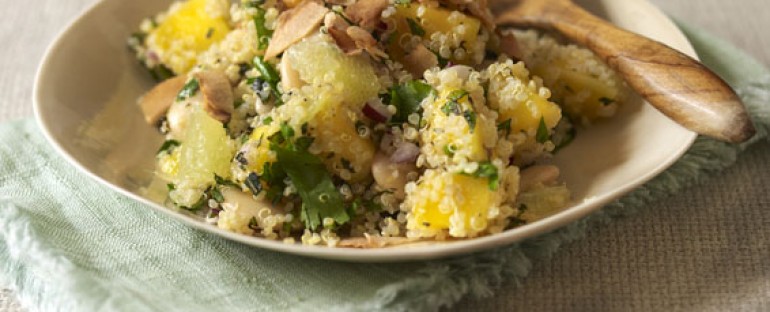
Day 2 of Gut Feeling Week (www.coeliac.org.uk) and here’s another lovely recipe taken from The Gluten Free Cook Book DK (ISBN 978-1-4053-9431-4). Don’t forget 2 lucky people can win a copy of the book - details of what you need to do are in yesterdays post. Quinoa salad with mango, lime, and toasted coconut Serves 4 Prep 15 mins Cook 10 mins A healthy salad full of big, tropical flavours and bright colours. Try to get Alphonso mangoes, if possible, which are famed for their sweetness. 1 Toast the coconut by dry frying it in a pan over a medium heat for 2–3 minutes until golden, stirring so that it doesn’t burn. Remove from the heat and allow to cool. 2 To make the dressing, place all the ingredients in a small bowl or jug and whisk. Taste and adjust the seasoning as needed. 3 Cook the quinoa according to pack instructions. Drain well and tip into a large serving bowl. While the quinoa is still warm, stir through the butter beans, onion, mango, lime, mint, and parsley, and season. 4 Pour over the dressing and stir well. Sprinkle the toasted coconut on top and serve immediately. 50g (13⁄4oz) desiccated or flaked coconut 300g (10oz) quinoa 400g can butter beans, drained and rinsed 1⁄2 red onion, finely chopped 1 large mango, peeled, stoned, and cut into bite-sized pieces 1 lime, peeled, segmented, and segments halved handful of mint, finely chopped handful of flat-leaf parsley, finely chopped For the dressing 3 tbsp olive oil 1 tbsp white wine vinegar pinch of sugar salt and freshly ground black pepper Per serving Energy 460kcals/1935kJ Protein 15g Fat 20g Saturated fat 8g Carbohydrate 54g Sugar 12.5g Fibre 7.5g Salt 0.8g
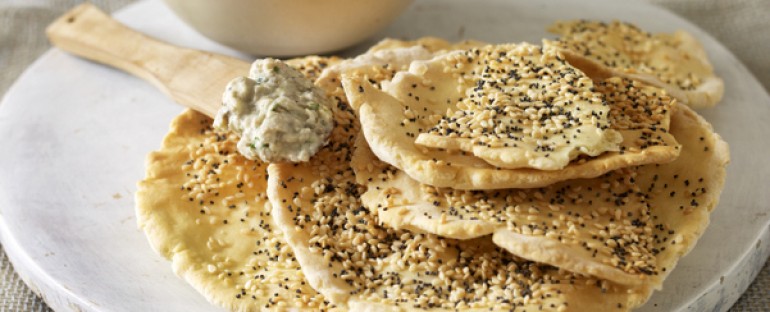
Lavosh with aubergine dip Serves 8 Prep 20 mins Cook 1 HOUR 10 MINS Iranian-style seeded crisp breads served with a sesame scented aubergine dip perfect for a snack or appetiser. 150g (51⁄2oz) gluten-free plain flour, plus extra for dusting 2 tsp xanthan gum 1⁄2 tsp salt 2 egg whites 15g (1⁄2oz) butter, melted 2 tbsp sesame seeds 1 tbsp poppy seeds For the dip 2 medium aubergines 2 garlic cloves, crushed zest and juice of 1 lemon 3 tbsp tahini paste 1⁄2 tsp salt 90ml (3fl oz) olive oil 3 tbsp finely chopped fresh coriander 4 tbsp Greek yogurt freshly ground black pepper 1 Preheat the oven to 200°C (400°F/Gas 6). For the dip, bake the aubergines on a baking tray for 30–40 minutes or until soft and lightly charred. Cool. 2 Meanwhile, make the lavosh. Sift the flour, xanthan, and salt into a large bowl. Beat 1 egg white with 90ml (3fl oz) water, stir into the flour with the melted butter, and mix well to form a dough. Lightly knead the dough on a floured surface, divide into 6 balls, and roll out each ball until paper thin, then place on baking sheets. Repeat with all the dough. 3 Brush the remaining egg white over the lavosh, sprinkle the seeds, and bake in 2 batches for 10–15 minutes or until crisp and golden. 4 Halve the aubergines and scoop the flesh into a food processor. Add the rest of the ingredients and blend to a chunky spread. Check the seasoning, spoon into a bowl, and serve with the crisp breads. Cook’s Tip You can also store the lavosh, after it has cooled, in an airtight container for 2–3 days. Re-crisp in a warm oven. The dip can be stored for 2–3 days in an airtight container in the fridge. Per serving Energy 226kcals/994kJ Protein 5.5g Fat 17g Saturated fat 3.5g Carbohydrate 15.5g Sugar 1.5g Fibre 3g Salt 0.6g Recipe from The Gluten Free Cook Book, Heather Whinney, Jane Lawrie & Fiona Hunter DK publishing (ISBN 978-1-4053-9431-4)
Have You Got a Gut Feeling? This week is ‘Gut Feeling Week’ a campaign run by Coeliac UK designed to improve awareness about Coeliac Disease. First some facts and figures about the condition 1 in 100 people in the UK have Coeliac Disease, however only 1 in 8 of those with the condition are diagnosed, which means around 500,000 people in the UK may have the disease without knowing it. Coeliac disease can occur at any age, symptoms may first appear when a baby is weaned onto wheat containing cereals, but it is can also occur later in life. A study carried out by the Mayo Clinic in conjunction with the University of Minnesota found that the number of people suffering from Coeliac Disease has quadrupled in the last few decades. Diagnosis of Coeliac Disease is not always straightforward and Coeliac UK say it takes an average of 13 years for people to be diagnosed. To help publicise Gut Feeling Week and demonstrate just how delicious a gluten free diet can be each day this week I will post a recipe taken from the Gluten Free Cook Book (ISBN 978-1-4053-9431-4) written by yours truly along with Heather Whinney and Jane Lawrie and published by DK. The book explains more about the condition and what it means along with practical advice about how to follow a gluten free diet and 230 delicious recipes. The publishers have very kindly agreed to give away 2 copies of the book to readers of this blog. To win a copy all you need to do is answer the following question then leave your name and email address in the comments box. To qualify for the prize draw entries need to be in before 19th May. Which of these grains is NOT gluten free? a) Spelt b) Buckwheat c) Quinoa For more information about Coeliac Disease and the Gut Feeling campaign go to www.coeliac.org.uk
Update on my letter to the Sunday Times - 8th May 2013 Dear Fiona Hunter Thank you for your email about the graphic which was published with the article “‘Natural’ food has more sugar than Coca-Cola”. You are right that it would have been more accurate to compare the same portion sizes. We plan to publish a clarification on Sunday. Thank you for keeping us on our toes. Yours sincerely Parin Janmohamed Letters Editor So, The Sunday Times were decent enough to admit their article was misleading. You will have to make your mind up as to whether it was a case of sloppy journalism or a blatant attempt to mislead. My guess it was simply a case of ‘never let the facts get in the way of a good headline’. Once again this only serves to remind us, as I said in my previous blog, that the mass media is not an extension of the education system; their aim, too often it seems, is to entertain not to educate. Unfortunately there are too many journalists, too ready to hop on the band wagon and give publicity to faddist, fashionable theories about diet with little concern for the quantity or quality of the underlying evidence. As promised The Times did indeed issue a very short, teeny tiny, ‘clarification’ at the bottom of their letters page in this week’s paper.
Sunday Times Letter 8th May 2013 As a qualified nutritionist I share your concerns over the high levels of sugar in some foods but felt the article, Natural food has more sugar than Coca-Cola, in this week’s Sunday Times (5/5/13) was both misleading and showed a wilful disregard for communicating a balanced message to your readership. Looking at one nutrient, in this case sugar, in isolation of the other nutrients a food offers is short sighted and demonstrates a lack of understanding. Cranberry juice, for instance, provides vitamin C and phytochemicals which offer protection against Urinary Tract Infections. In their natural form cranberries are very sour and the addition of sugar is necessary to make the drink palatable. I am at a loss to understand why the article compares the sugar in 1 litre of cranberry juice with the sugar in just 330mls cola. This is either very sloppy journalism or a genuine attempt to mislead. When making comparisons it’s important to compare like-with-like, either on a weight for weight basis or per portion. A typical 200ml glass of cranberry juice drink would provide the equivalent 5.6 teaspoons of sugar. Sugar in fruit yogurt is a little more difficult to defend. If you want to eat fruit yogurt the most nutritious way to do so is to add fresh fruit or fruit puree to plain yogurt. Adding fruit will help you reach your five-a-day target, adds vitamin C, fibre and phytochemicals and natural sweetness as opposed to ‘added’ sugar. Having said that, suggesting, as your article does, that Rachel’s low fat yogurt, contains the equivalent of 15.5 teaspoons sugar, is once again misleading, firstly because this figure is based on natural sugar (i.e lactose from milk) along with added sugar and secondly because the figure you give is for 450g of yogurt – this is equivalent of three servings. Another important point your journalists fail to make is that cola and many other soft drinks contain what nutritionists refer to as empty calories, what this means is sugar without the benefit of any other nutrients. In many of the other food and drinks mentioned in the article sugar comes packaged with other beneficial nutrients like calcium, dietary fibre and vitamin C. It seems to be me that in pursuit of a sensational headline you have demonstrated a sensational lack of objectivity and wantonly failed to communicate a balanced message.
 Latest Tweets
 RT @healthyfoodmag: If colder days and darker nights leave you feeling miserable, this article is for you. HFG nutritionist,… Click here for link,
 - Lunch at Flax and Kale, #superhealthy #super tasty #❤️Barcelona @ Barcelona, Spain Click here for link,
- Why cooking from scratch is the way forward Click here for link,
- RT @TelegraphFood: Is organic food really healthier? Nutritionist @fiona_nutrition helps bust the biggest food myths
Click here for link,